Llanelli Naturalists Newsletter - October 2002 - No 6
Sam D S Bosanquet
The most intensive period of bryophyte recording in Carmarthenshire since the time of H. H. Knight began in 1992 when Jonathan G. Graham and Graham S. Motley started working towards a Bryophyte Flora of the Vice County. Their recording, centered on the former Dinefwr District (ie essentially NE Carms), built up a picture of the status of many the county’s mosses and liverworts. Large gaps remained, however, in the rest of the county. SDSB moved to Pembrokeshire in 2000 and joined JGG and GSM on various trips to bryologically rich parts of Carmarthenshire. He also visited the county on his own on winter weekends to record in less-promising areas. The results of these weekend forays and more major expeditions, as well as collections from the Llanelli area and elsewhere by Ian K Morgan & R Nigel Stringer, have had a major impact on our understanding of the Vice County’s bryophyte flora. Distribution patterns have been elucidated and some species that were previously thought rare have been shown to be widespread, albeit at low density. Moreover, 19 species that were completely unknown in VC 44 have been recorded in these two years.
New species
 Unusual among bryophytes, Aulacomnium androgynum has an eastern distribution in Britain. It is common in the English midlands, occasional in Monmouthshire and decidedly rare in Glamorgan and Breconshire. The first confirmed Carmarthenshire record came from the extreme south-east of the county, at Bynea (SS59) in 2001. In Monmouthshire it is locally frequent in plant pots. Its drumsticks of yellowy-green gemmae are unique and easily recognised - it may even be growing in your garden!
Bryum dunense is a coastal relative of the ubiquitous tarmac-dwelling B. bicolor. Following its discovery on the Marros coast (SN20) in 2000 it was recorded in 2001 in the dunes at Pembrey; further colonies undoubtedly await discovery.
One of the few benefits of the FMD outbreak was a shift in our bryological focus towards industrial sites on the Llanelli coast. Searches of heavy metal-rich sites, recommended by IKM, turned up various uncommon metallophytes including the Nationally Scarce Bryum pallescens. This species is seen at its best at Burry Port (SN40) where it grows in swelling turfs below dripping walls made of copper slag. SDSB has also recorded it recently in Pembrokeshire and Glamorgan under roadside crash-barriers where metal-rich water drips onto the ground. Searches may reveal B. pallescens to be widespread in this habitat in Carmarthenshire.
Once it has been seen for the first time, Bryum radiculosum is relatively easily recognised although microscopic searching for tubers is required for 100% confirmation. Because of this complication it was not recorded as a Carmarthenshire moss until 2000 and remains dramatically under-recorded. It grows in small shiny tufts on wall mortar and has been seen at sites across the entire county.
Bryum sauteri is another tuberous Bryum, this time favouring slightly acidic soil. The first specimen for the county was collected on a hedgebank near Llanybri (SN31) in early 2001 and the second was found later in the year near Glandy Cross.
There was no doubt that the obscure tuber-producing species Bryum violaceum was growing somewhere in Carmarthenshire as it has been found in at least one location in every other county in Wales. Despite this, it eluded detection until late 2001 when a specimen was collected from a gravelly gateway a mile north of Llandyssilio (SN12).
Confused is probably the best word to describe the history of Didymodon (Barbula) nicholsonii in Britain. Until recently it was thought to be a scarce inhabitant of silty riverside rocks (Smith, 1978). By the late 1980s certain bryologists were finding colonies of D. nicholsonii on wet tarmac throughout Britain. Following the first record from Myddfai (SN72) in 2000 there have been more than 15 records of colonies of this species in VC 44. All of these colonies are on wet tarmac and it seems likely that its population has increased dramatically, reflecting the increased tarmac and car-produced nutrient enrichment, since the time when Knight recorded in the county.
A strong colony of Grimmia hartmanii was found by SDSB and GSM in the gorge of the Afon Sawdde in 2000. The humid conditions demanded by this species are present in various river gorges in Dinefwr and the discovery of further colonies is expected.
Gravelly tracks in the uplands provide the locus for Pohlia drummondii in VC 44. The first two records of this species were from typical upland tracks near Cwrt-y-cadno (SN74); much more unexpected was a colony on a track by the Afon Cynin (SN22) south of Trelech. P. drummondii certainly has more specialised habits than its relative P. annotina but its precise requirements remain unclear.
Pohlia flexuosa (P. muyldermansii) is another upland relative of P. annotina which, like P. drummondii, has rather precise habitat demands. P. flexuosa is a rarity in south Wales, known previously from a sandstone outcrop in Glamorgan and a moorland stream-bank in the southern Brecon Beacons. A single tuft was found on a wet, gravelly rock ledge on Bannau Sir Gaer during an August visit by SDSB and GSM to this rich site. It was spotted because SDSB had seen it five days previously on a reservoir margin in Scotland.
Although Schistidium platyphyllum was only recognised as a species separate from Schistidium rivulare in the late 1990s it had been recorded at varietal level for a number of years. A specimen was collected in 2000 from a rock on the Carmarthenshire bank of the Eastern Cleddau (SN01) near Cleddau Bridge.
Scleropodium cespitans is a difficult species to recognise and the single Carmarthenshire record, from the Llansteffan peninsula (SN31), may represent under-recording. Its ecological requirements - rocks occasionally flooded by calcareous water - are not met in much of the county and it may therefore only occur, as near Llansteffan, on wet tarmac.
Although it is known from several scattered sites in the Brecon Beacons National Park, Tetrodontium brownianum was not found in Carmarthenshire until 2001, when a small colony was located by SDSB & GSM in a shady crevice in an Ordovician outcrop south of the National Nature Reserve at Allt Rhyd-y-groes (SN74). A second colony was found in the extreme south of the county at the end of the year, on a Farewell Rock outcrop in a river gorge near Pontyberem. Suitable habitat is found elsewhere in Dinefwr and Llanelli but no further sites have been discovered; this is, however, an extremely difficult species to spot in the field.
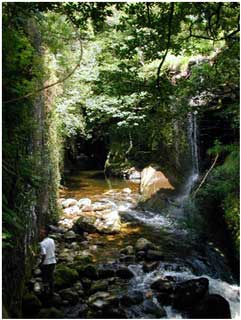 The upsurge in records of Cololejeunea minutissima is dramatic by any standards. It was first found on an Elder bush behind Morfa Bychan, Pendine (SN20) in early 2000. This strictly coastal species was then found in almost every tetrad surveyed between the Pembrokeshire border and Machynys with records inland as far as Alltwallis (SN43). It cannot possibly have been this widespread in the county in the early 1900s or it would surely have been known to Knight (he had seen it elsewhere in Britain). New records from further east in Wales, where it is still very sparse, suggest that it has spread eastwards through Carmarthenshire in the recent past. It is tempting to think that the warmer, wetter weather we are now experiencing may favour this and other humidity-demanding bryophytes.
The smell of bryophytes is not widely appreciated - Frullania fragilifolia smells of pear-drops. This was a useful recognition character when it was found in block scree at Morfa Bychan, Pendine (SN20), many miles from its nearest known site on the Pembrokeshire coast. In north Wales, F. fragilifolia is also found in humid ravines; it is probably present somewhere in SN74 although finding it among the abundant F. tamarisci may need a well-trained nose.
Harpalejeunea molleri is a humidity-demanding species that is locally frequent in western Scotland and occasional in North Wales. Three records from SW England and one from Hampshire hinted at the possibility of H. molleri being in Carms. Its discovery by GSM, JGG & SDSB on a base-rich rock face in the Cothi gorge, Cwrt-y-cadno (SN74) was the highlight of our first visit to the site.
H H Knight’s record of Hygrobiella laxifolia on the Brecknock side of Cwm Twrch (SN71) led GSM, IKM & SDSB to explore this rocky gorge in summer 2001. To our surprise, Hygrobiella proved to be frequent on wet rock-faces on both sides of the gorge. Frustration was provided by Graham’s discovery of Cololejeunea calcarea on the wrong (Brecknock) side of the Twrch, it has still never been found in Carmarthenshire!
Unlike Harpalejeunea molleri, no records of Metzgeria leptoneura exist for SW England. Its discovery in the Cothi Gorge in November 2001 was the first British record south of Cwm Rheidol in northern Ceredigion and, although dreamed of, was very unexpected. It added to the already considerable bryological interest known from the gorge.
Plagiochila bifaria (killarniensis) was collected for the first time in Carmarthenshire by SDSB & GSM at RSPB Dinas in 1999. The depauperate specimen was not correctly identified until 2001 by which time two further sites had been discovered. Both of its Welsh habitats are represented in VC44: it was found on a coastal bank by Llansteffan Castle and on rock-faces in the humid Cothi Gorge.
Other notable species
Amphidium lapponicum has been known from Bannau Sir Gaer (SN82) since 1978 but its status was unclear. Surprisingly, considering it has never been found elsewhere in south Wales, it was found to be frequent on these crags during a visit by SDSB & GSM in 2001.
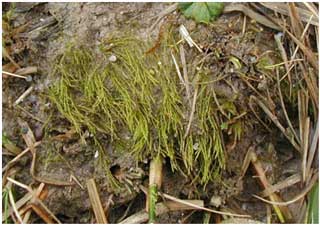 Archidium alternifolium was recorded for the first time in the county in more than 50 years on a wet roadside bank near Llanybri in 2001. A second record followed at the end of the year - IKM & RNS collected A. alternifolium from a quarry at Llansawel.
Knight’s site for Coscinodon cribrosus on crags above Marros Mill (SN20) was revisited twice, almost 100 years since Knight was there. British expert Nick Hodgetts visited in 2000 during an unsuccessful search for Grimmia alpestris (the only British specimen of G. alpestris was collected from here by Knight), while SDSB visited in early 2001. The Coscinodon remained locally abundant.
The first record of Distichium inclinatum away from its Foel Fawr (Mynydd Du) heartland came from the mortar of a ruined building at the southern end of Cwm Twrch (SN71).
Entosthodon attenuatus was recorded twice in 2001, the first records since Knight’s time. One tuft was noted on a crag in Allt Rhyd-y-groes NNR (SN74) whilst it was fairly frequent in Cwm Twrch (SN71) with its marginally commoner relative E. obtusus.
From a position of obscurity, Epipterygium tozeri has risen to being a well known species in the south of the county. It is almost ubiquitous in small quantity on hedgebanks on the Llansteffan peninsula and occurs in greater quantity at scattered riverbank sites elsewhere.
The third county site for Eurhynchium speciosum was found in Alder carr south of the National Botanic Garden of Wales (SN51) during a bryological survey of the gardens by SDSB.
Hamatocaulis (Drepanocladus) vernicosus continued to prove that it isn’t as rare as its Schedule 8 status suggests. Knight’s site in the centre of Mynydd Mallaen (SN74) was relocated by SDSB whilst GSM found new sites below Foel Fawr and in flushes east of Myddfai.
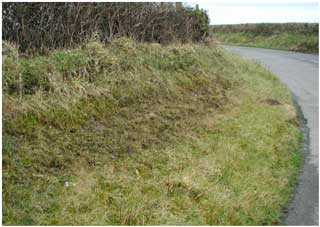 A roadside rock less than 100m from the Pembs border north of Glandy Cross (SN13) produced the first modern Carms record of Hedwigia stellata in late 2001.
Pohlia elongata, previously thought to be very rare in the county, was recorded at six upland sites in Dinefwr in 2001.
Rhodobryum roseum is supposed to be an uncommon species of chalk and limestone grassland, as at Foel Fawr where it was found by GSM in 2000. A strong colony on a roadside bank near Coombe Cheshire Home, S. of Llangynog (SN31), only the third county site, was therefore a huge surprise.
Jonathan Graham found a colony of the tiny (1mm tall) Seligeria acutifolia on limestone on Foel Fawr in the 1990s. A visit by GSM & SDSB in 2001 showed that the species is widespread in small quantity on natural limestone outcrops there.
Carmarthenshire’s cliff coast is well-developed in only very few places. The cliff-slump moss Tortula viridifolia, ubiquitous on the Pembs coast, was found in the little suitable habitat we have - at Llansteffan, Marros and Amroth - in 2001.
A peculiar form of Weissia controversa, possibly the lead-mine taxon “var. densifolia”, was found to be co-dominant with Bryum pallescens on metal-rich soil at Burry Port (SN40) and Bynea (SS59). Its taxonomic status has yet to be confirmed.
The second county site for Weissia brachycarpa var brachycarpa was unearthed in a dry “prairie” flower-bed in the National Botanic Garden of Wales. Reaction from the Gardens staff was encouragingly positive and the future of W. brachycarpa looks healthy.
Following a 100 year gap, three colonies of the distinctive thallose liverwort Blasia pusilla were found at the extremes of the county - Mynydd Mallaen (SN74), Pwll fly ash lagoon (SN40) and Efailwen (SN12).
The report of Petalophyllum ralfsii from Pwll fly-ash lagoon (SN40) (Bull. Llanelli Nats. 6) is unfortunately erroneous. The species involved was shown by SDSB to be the similar-looking Fossombronia incurva; probably more exciting as this is only its second county site. Real P. ralfsii was found by GSM in even more improbable circumstances: on dumped coastal sand at Nant-y-bai lead mine near Rhandirmwyn (SN74).
 Jubula hutchinsae is still an exciting find despite at least 13 new localities being discovered in various gorges in SE Carms (IKM, RNS & SDSB), near Newcastle Emlyn (SDSB) and in the Cothi Gorge, Cwrt-y-cadno (GSM). It demands high humidity and shows a similar distribution to Hay-scented Buckler-fern Dryopteris aemula. It seems likely that a lack of exploration of this habitat had led to J. hutchinsae being under-recorded and that the species is not increasing in range.
A well-trained nose helps with finding Lophocolea fragrans as its peppery smell picks it out in colonies of Lejeunea lamacerina. Several new sites were found in the south of the county especially around Kidwelly.
Two new sites for Marchesinia mackaii, a calcicole of dry but humid rock faces, were found at opposite extremes of the county - in RSPB Dinas (SN74) and near Llanddowror (SN21).
Despite no Ceredigion records, Carmarthenshire now boasts three sites for the humidity-demanding Plagiochila exigua. The new localities, discovered in 2001, were the Cothi Gorge, Cwrt-y-cadno and a gorge on the northern edge of Caeo Forest (both SN74).
The Nationally Scarce aquatic Porella pinnata was found on two new rivers in 2001 - the Eastern Cleddau near Efailwen (SN12) and the Taf near Llanddowror and Whitland (SN21).
Ian Morgan found two colonies of Riccia cavernosa near the north part of Pembrey Forest; there are still fewer than 10 Welsh records of this Nationally Scarce species.
Misunderstood assemblages
Many parts of SN74 support Grimmia donniana on rocks, Racomitrium elongatum on gravelly tracks and Scapania scandica on banks; all these species were thought to be rarities in the county until 2000.
Our ruderal flora remains little known but a wide variety of species including Bryum klingraeffii, Ditrichum cylindricum, Dicranella schreberana, Dicranella staphylina and Ephemerum serratum are all proving to be widespread at low density. A slightly different ruderal is Diplophyllum obtusifolium, a Nationally Scarce liverwort that colonises newly bare soil on banks by forestry rides, which was found at four new sites in Carmarthenshire during 2001.
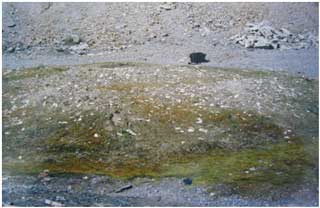 Pleuridium subulatum, Fissidens incurvus and Eurhynchium pumilum are all poorly understood weak-calcicoles that are proving to be widespread in the county, especially on the limestone south-east of Carmarthen. The first two species look similar to P. acuminatum and F. bryoides respectively and there is a tendency for observers to mis-record them. E. pumilum is small and easily ignored, particularly as it barely resembles any of the common Eurhynchium species.
The coastal levels around Llanelli are home to Tortula modica, Hennediella heimei and Microbryum davallianum, all of which were found to be much more widespread than was previously thought. T. modica and H. heimei were found particularly on low mounds at the upper edge of saltmarshes but both were also noted on other stony coastal ground. M. davallianum occurs especially on the upper edge of reen banks and this seems to be its principal habitat in the county in contrast to its preference for dry calcareous conditions in Pembrokeshire and Monmouthshire.
Taxonomic change has altered our understanding of Schistidium. We used to think that S. apocarpum was ubiquitous, it now appears to be rare and confined to humid localities while the newly described S. crassipilum is the ubiquitous species.
Southern Carmarthenshire has proved to be a hotbed for previously under-recorded epiphytic species. Orthotrichum had been very poorly understood and many new localities have been found for each of the less common species. In order of frequency in the county, the epiphytic Orthotrichum spp. are (approx % of tetrads where a recording visit reveals presence): O. affine (100%), O. diaphanum (80%), O. pulchellum (50%), O. tenellum (40%), O. stramineum (25%), O. lyellii (15%), O. striatum (<10%). Ulota phyllantha seems to be scattered throughout the county in small quantity. In contrast, Zygodon baumgartneri remains a sought-after rarity with new records from old Ash trees in the National Botanic Garden of Wales and near Llanddowror being the first for several years.
The future
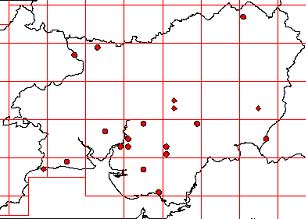 There is little doubt that more species, already known from adjacent vice-counties, await discovery in Carmarthenshire. Despite appearing very well explored, the most humid parts of SN74 surely hide gems such as Aphanolejeunea microscopica, Harpanthus scutatus and Radula aquilegia. Bannau Sir Gaer may have been visited regularly but Frullania microphylla var. deciduifolia (known from just 3 British sites, 2 of them in the BBNP) has not yet been found there. Natural limestone outcrops should be searched for two tiny species - Cololejeunea calcarea and Seligeria pusilla. The silty banks of the Tywi and Taf are almost unvisited and may support Henediella stanfordensis or even Myrinia pulvinata. Maybe the 2002 visit of the British Bryological Society to the county, based at Glynhir Mansion, will find some of these.
Stop press
Recording has continued apace in 2002 and several interesting discoveries have been made; the majority will be reported at a later date. One significant site deserves mention however. Our first visit to a disused quarry near Llangynog revealed a very significant bryophyte assemblage. A large tuft of Grimmia laevigata, new for west Wales, was the star find. Supporting cast included a strong colony of Aloina ambigua, new for the county, growing with A. aloides; a fruiting tuft of Grimmia decipiens, the first west Wales record since Knight found it near Pendine in 1909; the second modern record of Hedwigia stellata; the third colony of Fossombronia incurva in the county; and a few tufts of Grimmia donniana, many miles from their nearest known localities on Mynydd Mallaen. A return visit later in the year will focus on the critical genera Schistidium and Racomitrium and it is hoped that further interesting species will be found.
