Llanelli Naturalists Newsletter - June 1984
R.N. Stringer and R.H. Davies
The source of the River Loughor lies two kilometres south of the ruins of Carreg Cennen Castle in the Parish of Llandeilo Fawr.
We arrived in the area one Sunday morning expecting to find he river arising as a small rivulet amongst the peat clad uplands of Banwen Gwythwch.
Imagine our surprise, however, when we were confronted by a raging torrent arising from the base of a limestone rock face. This is Llygad Llwchwr - ¬the "eye" of the Llwchwr and it is the nature of the river's origin that has given it its name.
In very early times the area was inhabited, by Celts of Irish origin who christened the river “Lloch Vawr” which was later shortened to Llwchwr. Lloch means lake or, loch and it comes as no surprise to learn that the area behind the llygad is riddled with passages and caverns through which this great volume of water travels, in "fact it is a true aquifer. In 1843 the path of the river was traced from its emergence back through the underground labyrinth by Thomas Jenkins and his fellow companions.
They entered the mountain through a cave entrance 10 foot above the river and after travelling about 50 foot came across a cavern inside which they found some "splendid geological formations" which :were described and recorded in a diary kept by the author and leader.
One passage reads in one (cavern) there is a plank of stalactites extending from roof to floor which when struck with a ;hammer emits as fine and loud a sound as one of the largest bells in Llandeilo steeple". This cavern they christened the Bell Cavern.
This aversion for noise was again demonstrated another time by taking a pistol into the cavern and firing this off. The noise apparently "rivalled the loudest thunder”. ¬Not to be perturbed our intrepid deaf? Explorers returned with ropes, ladders and a portable collapsible coracle and eventually reached a distance of 567 foot from the cave entrance.
They were however unable to go any further and the real source of the Loughor remained a mystery once again. They then thought that Llyn-yfan may have been a starting point and this was tested out by dumping a huge amount of chaff into the lake and noting the presence of chaff issuing forth from Lygad Llwchwr. This apparently proved successful although no modern day scientific evidence can confirm this.
The force of water issuing from the Llygad Llwchwr is tremendous and the volume of water has been recorded as 45 Hogsheads per minute, (2312.5 gallons or 12 Ton 11 cwt and 12 lb). We weren’t able to check this but a Davies bacon butty soon shot off downstream in no time at all during our lunch break!
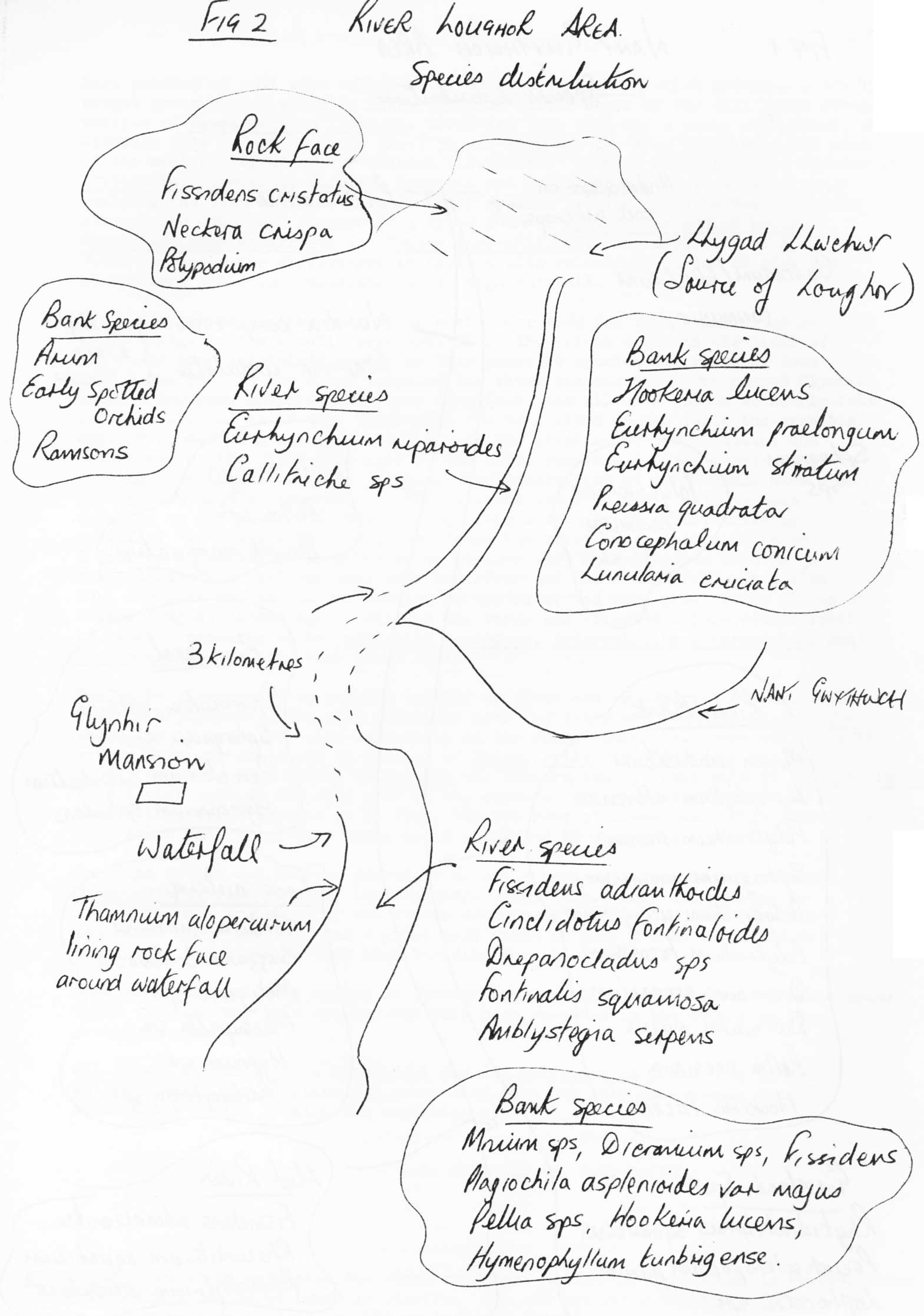
The area around Llygad Llwchwr comprises mainly of a remnant of an Ashwood with a very limited ground flora due to excessive trampling by cavers and ramblers. Wild Arum was emerging as well as quite a few Early Purple Orchids, but these; the Callitriche species in the fast flowing water, and the Polypodium species growing in profusion up the trunk of an Ash tree in the stream took second place even to us botanists when all in the space of an hour we saw a Dipper, Short-eared Owl, Buzzards, Stoat, and boxing March Hares (we assume they were hares but being botanists we didn’t really know what we were rabbiting about).
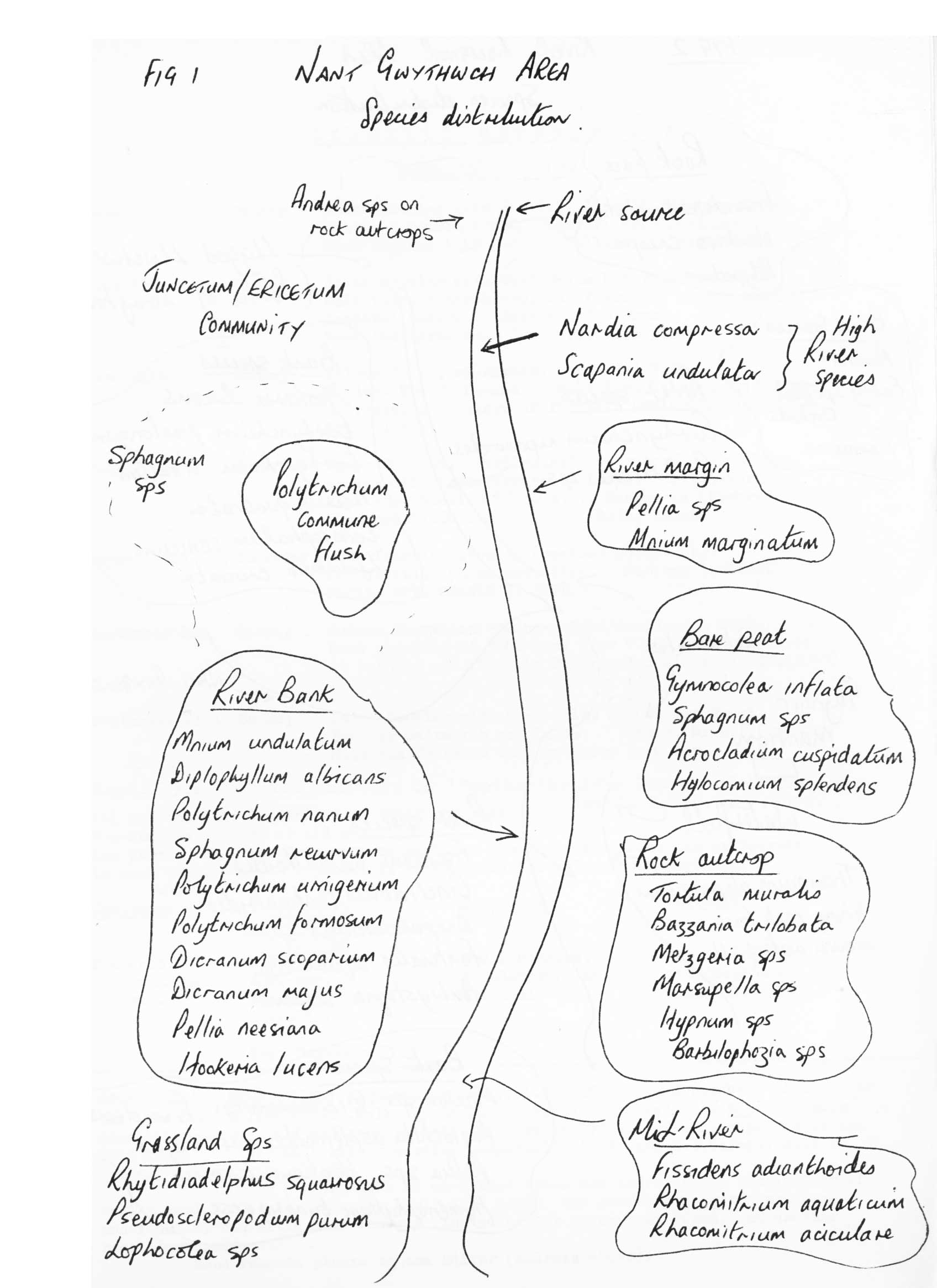
Further downstream the Llwchwr is joined by another tributary, Nant Gwythwch, at a point of about a kilometre from its source. It is here that our Bryophyte recording journey started. Nant Gwythwch, in keeping with the main river Llwchwr also arises from a single point source in the hillside with great force before making its winding, tumbling course down the hillside. At the source we found our first Andrea species (indicative of mountainous region) as was an early coloniser of the stream bottom Nardia compressa. Either side of the stream the acidic moorland of Ericetum/Juncetum community was interrupted by wetter areas dominated by Sphagnum species and in one particular area a huge flush area dominated by Polystichum commune var commune.
Bare patches of peat were colonised by Gymnocolea inflata which produces a lovely bright green carpet which is interrupted in wetter areas by the dull seen straggly thallus of Drepanocladus fluitans. Bordering this area was a rocky escarpment, which, although only foot high and about 50 yards long was the area where we found some of the most beautiful of our British liverworts. Species found included members of Tritomaria, Leiocolea, Porella, Bazzania and Barbilophozia species, many of which included the high altitude forms. Other species growing close to the limestone outcrop included more cosmopolitan types such as Pseudoscleropodium purum, Rhytidiadelphus squarrosus and Hynum cupressiforme. The diversity of species found indicated the differences in habitat with relation to pH due to high base status rock and acidic moorland due to high rainfall.
Nant Gwythwch joined the main river much lower down the Valley and although there was a change in the aquatic bryophyte flora the splash zone and the sides of the river bank maintained a more or less constant species distribution (see figs 1 and 2). As the slope lessened the river widened out a it passed Glynhir Mansion and once again we were very surprised when all of sudden we nearly fell over the edge of an 18 foot waterfall! On both sides of the falls the area was heavily wooded with mainly Ash but due to the planting of Laurel bashes the undercover on the right hand side of the river was very dense these shrubs growing to a height of about 15 foot. The description of dense could have also easily been used to describe our mental state after we spent half an hour crawling on our hands and knees through this area down to river. Cries by myself of "it's all right Dick, I’ve found the river" were soon muted when I fell in and hoots of laughter by my partner were soon quenched when he slipped over the vertical bank into to river and had a wellyfull. It seemed that our luck ties in because growing on the river bed were great white plumes of sewage fungus. About half a mile of the river was affected before recolonisation by aquatic mosses such as Fontinalis squamosus, Heterocladium heteropterum, and Drepanocladus unciatus took place again.
Not to be discouraged we trekked wearily up river and as expected the area was rich in bryophytes. The main coloniser near the falls was Thammium alorercurum which lay in great curtains especially on the rocky substrate. Bare soil near the waters edge was colonised by species of Mnium, Pellia and Fissidens but higher up the bank the lush growth of P. purum was interrupted by great mats of Hookeria lucsens. This latter species can only grow in the shade as direct sunlight kills it and easily identified because it is flat, its two rows of leaves on either side of the stem being made up of Jeri; large cells which can be seen with a x10 lens.
Our find of the day however proved to be not a moss or liverwort but a fern, Hymenophyllum tunbridgense, the 'Tunbridge filmy fern. This was growing in abundance (and fruiting) by the riverside amongst some moss. Like the moss described above the fern has a plant body which is only 1 cell chick and is completely dependent on very high humidity for its survival.
Such sites are not very common in Carmarthenshire which would be one of the reasons which explains why this species has only been recorded in the county on two previous occasions.
All in all it was quite - a successful day and only goes to prove that if you go out looking for rarities you never find there but only come across them accidentally whilst looking for something else.
Stop Press
As if to emphasise the above statement Maidenhair fern found in Pembrokeshire and Polypodium X mantoniae found in Dinefwr. (We are now going to record ferns - it’s easier - they seem to find us and not us look for them!